
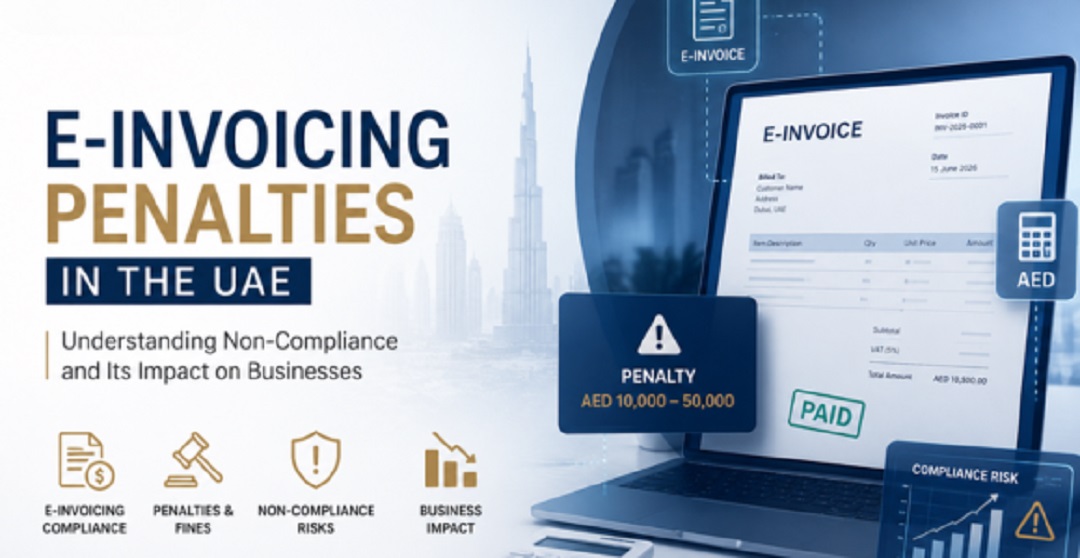

With UAE e-invoicing becoming mandatory in phases from 2027, it’s natural to ask: what actually happens if my business isn’t ready in time? The honest answer is that the risk goes beyond a simple fine — it touches your customer relationships, your VAT recovery position, and even your ongoing access to FTA services.
Penalties Are Coming — Confirm the Exact Figures With the FTA
The Federal Tax Authority has signalled that penalties will apply to businesses that fail to issue, transmit, or report e-invoices correctly once their phase becomes mandatory, and that these penalties can recur for ongoing breaches rather than being a one-time fine. Because penalty schedules can be updated as the framework is finalised, always confirm the current figures directly with the FTA or with your tax advisor before relying on a specific number — this post will be updated as official figures are confirmed. What’s clear already, though, is the direction of travel: continuous, systemic non-compliance is treated more seriously than an isolated error, which is exactly why building a reliable process now matters more than memorising a specific fine amount.
The Risk That’s Easy to Overlook: Your Customers’ VAT Recovery
Here’s the part that often gets missed: if you issue a non-compliant invoice, it’s not just your business that’s at risk. Your customer may find their own VAT input recovery compromised, because they can’t reclaim VAT on an invoice that doesn’t meet the required format.
That means a non-compliant invoice doesn’t just cost you a potential fine — it can damage the commercial relationship itself. A B2B customer who has to chase you for a corrected, compliant invoice (or who loses input VAT recovery because of your invoice) is far less likely to continue working with you. In a market where B2B relationships often depend on trust and reliability, being the supplier whose invoices routinely cause problems for a customer’s own tax filings is a reputational cost that’s harder to reverse than a monetary fine.
Suspension of FTA Online Services
For businesses that show a pattern of continued non-compliance, the FTA has indicated that access to its online services can be suspended. Given that FTA online services are how you file VAT returns, corporate tax returns, and manage your overall tax compliance, this is a serious operational risk — not just an invoicing inconvenience. A business locked out of its own filing portal faces knock-on compliance problems well beyond the original e-invoicing issue.
Why “We’ll Deal With It Later” Is the Most Expensive Option
The businesses most at risk here aren’t the ones actively resisting e-invoicing — they’re the ones who plan to “figure it out closer to the deadline.” In practice, that approach tends to backfire for a few predictable reasons:
- ASP onboarding takes time, and providers will have longer queues as the deadline approaches
- System integration issues are far easier to catch and fix during a calm pilot period than during a rushed, mandatory go-live
- Your accounting and tax data need to be accurate before they can be converted into compliant structured invoices — cleaning up messy or incomplete invoicing data under deadline pressure is harder than doing it now
- Staff need time to adjust to new invoicing workflows, and rushed training under deadline pressure tends to produce more errors in the first months of going live, right when the FTA’s attention is likely to be highest
The Cost of Getting It Wrong vs. the Cost of Preparing
It’s worth framing this plainly: the cost of a readiness assessment and a properly chosen ASP is a known, manageable, one-time investment. The cost of non-compliance — potential penalties, disrupted customer relationships, and possible suspension of FTA services — is open-ended and largely outside your control once it starts. Framed that way, the “wait and see” approach isn’t really the cheaper option; it’s simply the option where the cost is deferred and less visible today.
What Preparing Now Actually Looks Like
You don’t need to solve the entire e-invoicing transition in one sitting. A sensible first step is a readiness assessment: reviewing your current invoicing process, your accounting system’s compatibility, and your realistic deadline based on your business size — so you know exactly what needs to happen and by when. From there, ASP selection, data cleanup, and a pilot run with live invoices can proceed in a controlled sequence rather than all at once under deadline pressure.
Don’t wait for the deadline to find out what’s not ready. Book a free e-invoicing readiness consultation with VAT Accounting UAE, and let’s map out your compliance plan now, while there’s still time to do it properly.
Frequently Asked Questions
Q1. What penalties apply for UAE e-invoicing non-compliance?
The FTA has indicated that penalties will apply for failing to issue, transmit, or report e-invoices correctly, and that these can recur for ongoing breaches. Exact figures should be confirmed directly with the FTA or your tax advisor, as they may be updated as the framework is finalised.
Q2. Can my customer be affected if I send a non-compliant invoice?
Yes. Your customer may be unable to recover VAT on an invoice that doesn’t meet the required PINT-AE format, which can strain the commercial relationship even beyond any penalty you face directly.
Q3. Can the FTA suspend my online services for non-compliance?
The FTA has indicated that a pattern of continued non-compliance can lead to suspension of online services, which would affect your ability to file VAT and corporate tax returns.
Q4. Is it better to wait until closer to my deadline to prepare?
No. Waiting typically means longer ASP onboarding queues, less time to catch integration issues, and more pressure to clean up invoicing data quickly rather than methodically.
Q5. What’s the first step in preparing for e-invoicing?
A readiness assessment — reviewing your current invoicing process, checking your accounting system’s ASP compatibility, and confirming your applicable deadline based on business size.