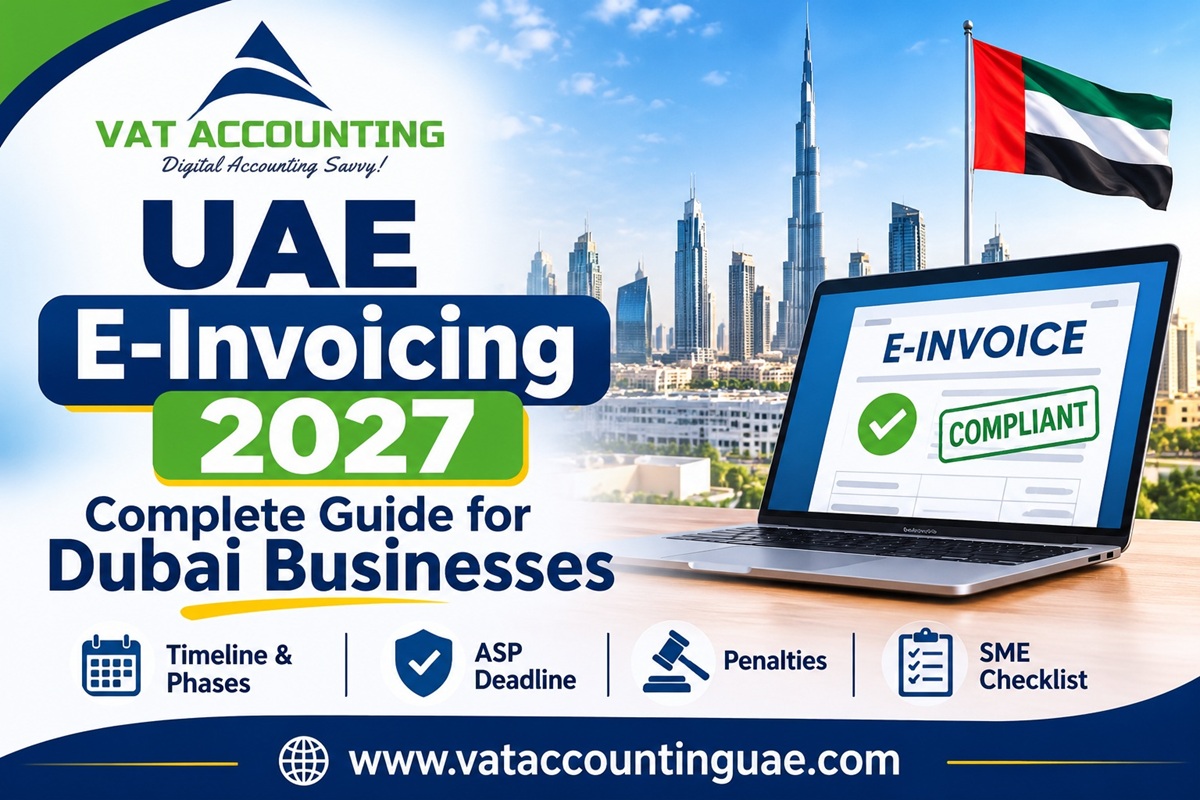

UAE e-invoicing is changing the way every business in Dubai and across the Emirates issues, sends and stores invoices. For years, companies relied on paper copies, emailed PDFs and spreadsheets to bill customers and record purchases. That era is now closing, because the Ministry of Finance has introduced a national electronic invoicing system that replaces manual and PDF-based billing with structured, machine-readable data exchanged through approved networks.
If you run a company in Dubai, Abu Dhabi, Sharjah or any other emirate, this e-invoicing guide UAE will walk you through what you need to know. We explain who is covered, how the phased timeline works, what an accredited service provider does, which penalties apply and how small and medium businesses can get ready without disrupting daily operations.
The rollout is not a distant plan anymore. A pilot began in July 2026, and the first mandatory phase starts on 1 January 2027, so UAE e-invoicing mandatory requirements are arriving fast. Businesses that prepare early will avoid last-minute stress, reduce errors in their VAT filings and keep their cash flow moving smoothly.
This article is written for finance managers, business owners and accountants who want a clear, practical overview. Whether you are searching for e-invoicing compliance Dubai support or simply trying to understand UAE e-invoicing 2027, the sections below give you a complete roadmap you can act on today.
What Is UAE E-Invoicing and Who Does It Apply To?
UAE e-invoicing is a system in which invoices and credit notes are created, validated and exchanged electronically in a standard structured format, rather than as paper or simple PDF files. The invoice data travels from the seller’s accounting software to the buyer’s system through accredited providers, and the relevant information is also reported to the tax authority.
The framework was established through Ministerial Decisions No. 243 and No. 244 of 2025, issued by the UAE Ministry of Finance. The system is built on the Peppol network using the Peppol PINT AE specification, which defines the data fields and format that every compliant e-invoice must follow.
In terms of scope, the mandate focuses on business-to-business and business-to-government transactions. Business-to-consumer invoicing is not currently included. Even a company that is not yet required to issue e-invoices will still need to be able to receive them, because its suppliers who fall within the mandate will send invoices in the new format.
For Dubai businesses, this means the change touches far more than the accounts department. Sales, procurement, finance and IT teams all play a part, since invoices will flow directly between systems. Understanding the scope early is the first step toward smooth e-invoicing compliance Dubai companies can rely on.
UAE E-Invoicing Timeline: Large Companies vs SMEs
The Ministry of Finance has chosen a phased approach so that businesses of different sizes get time to adapt. A pilot programme began on 1 July 2026 for selected taxpayers, with voluntary adoption available from that date. The pilot allows the system and the providers to be tested before the UAE e-invoicing mandatory phases begin.
The first mandatory phase covers businesses with annual revenue of AED 50 million or more. These companies were required to appoint an accredited service provider by 30 October 2026, after the original deadline was extended, and they must begin issuing e-invoices from 1 January 2027.
Smaller businesses, meaning those with annual revenue below AED 50 million, follow in the next phase. They are expected to appoint a provider by 31 March 2027 and go live from 1 July 2027. Government entities have a separate timeline, with mandatory adoption set for 1 October 2027.
This staggered schedule makes UAE e-invoicing 2027 a year of transition for the whole market. Even if your turnover is below the threshold, your larger customers will start sending structured invoices from January, so SMEs should not wait until the last quarter to begin planning. Dates can be adjusted by the authorities, so always confirm the latest position with the Ministry of Finance.
What Is an Accredited Service Provider (ASP) and What Is the ASP Deadline?
An accredited service provider UAE businesses must appoint is a company approved by the Ministry of Finance to connect taxpayers to the national e-invoicing network. The provider sends and receives invoices on your behalf, converts them into the required format, checks that all mandatory fields are present and passes the necessary data onward.
The UAE follows a decentralised model based on the Peppol framework, often described as a five-corner model. Your business connects to its own provider, your customer connects to theirs, and the providers exchange the invoice between them, while the tax authority receives the relevant data. This is why choosing the right provider matters.
Both issuers and recipients of invoices need to appoint a provider, so the obligation is not limited to sellers. The Ministry of Finance publishes the list of accredited providers, and businesses should pick one that integrates with their existing accounting or ERP software and supports the Peppol PINT AE format.
The ASP deadline for large businesses with revenue of AED 50 million or more was 30 October 2026, which has now passed. Companies that missed it should act immediately, appoint a provider and document their steps. For smaller businesses, the appointment deadline of 31 March 2027 is still ahead, and starting the selection process now leaves time for testing.
UAE E-Invoicing Penalties and Fines
The Ministry of Finance has set administrative penalties for businesses that fail to meet the e-invoicing timelines. The most visible one concerns delays in implementing the system or appointing an accredited service provider within the prescribed period. That penalty is AED 5,000 for each month, or part of a month, of delay.
Because the fine applies to part of a month as well, even a short delay can trigger a full month’s charge, and the amount keeps accumulating until the business becomes compliant. For a growing company, these costs are avoidable, yet they can quickly become a distraction from core operations.
Fines are only part of the risk. Invoices that do not follow the required structure can be rejected by the network, which means delayed payments, disputed records and difficulty in supporting input VAT recovery. Poor data quality at the source can also create mismatches between invoices and VAT returns.
For this reason, penalties should be viewed as a prompt to build a proper process rather than a threat to fear. Businesses that clean up their customer and supplier master data, review their invoice templates and test their systems early will find that e-invoicing compliance Dubai requirements become routine.
How SMEs Can Prepare for UAE E-Invoicing: Readiness Checklist
Small and medium businesses often assume that e-invoicing is only a concern for large corporations, but e-invoicing for SMEs UAE is just as important. Your first step is to confirm your annual revenue band and note your appointment and go-live dates, which for smaller businesses fall on 31 March 2027 and 1 July 2027.
Next, review your current accounting software. Check whether it can produce structured invoices in the Peppol PINT AE format or connect with an accredited provider. If your system is outdated or spreadsheet-based, this is the right moment to upgrade to cloud accounting that can handle electronic data exchange.
Then clean your data. Make sure customer and supplier names, tax registration numbers, addresses and product descriptions are accurate and consistent, because mandatory fields will be validated. Train your finance and sales teams on the new workflow, and define who approves, sends and reconciles each invoice.
Finally, shortlist providers, run test invoices and set up an archiving process, as invoices must be retained in electronic form for the required period. Following this readiness checklist step by step makes UAE e-invoicing manageable, even for a small team with limited technical resources.
How VAT Accounting UAE Can Help You Comply (Our Services and Contact Us)
VAT Accounting UAE is a Dubai-based firm that supports businesses with VAT registration, accounting and bookkeeping, corporate tax registration and corporate tax return filing. Because e-invoicing connects directly with these areas, our team is well placed to guide you through the change without disrupting your existing financial processes.
We start by reviewing how you invoice today, which systems you use and which revenue band you fall into. From there, we help you understand your timeline, prepare your data and align your invoicing with the UAE e-invoicing requirements, so you can choose an accredited provider with confidence.
Our accounting and bookkeeping services keep your records clean and consistent, which is essential once invoices are validated electronically. Our VAT and corporate tax specialists make sure that your invoices, VAT returns and tax filings tell the same story, reducing the risk of mismatches and queries.
If you want practical support with e-invoicing compliance Dubai businesses can trust, contact VAT Accounting UAE today. Share your current setup with our team, and we will outline a simple, step-by-step plan tailored to your size, sector and deadline.
Conclusion
The shift to structured electronic invoicing is one of the biggest changes in the country’s tax framework in recent years. This UAE e-invoicing overview shows that the rules are clear: a phased rollout, mandatory use of accredited service providers and the Peppol PINT AE format as the technical foundation.
For large businesses, the focus now is completing provider appointment and going live on 1 January 2027. For SMEs, the window between now and March 2027 is the best time to select software, clean data and train teams. Either way, UAE e-invoicing mandatory rules reward early action.
A good e-invoicing guide UAE businesses can follow always comes back to the same basics: know your dates, choose the right provider, keep your data accurate and archive every invoice properly. These steps protect you from penalties and keep your VAT reporting consistent.
If you need help turning this plan into action, VAT Accounting UAE is ready to support you. Reach out to our Dubai team to make UAE e-invoicing 2027 a smooth transition rather than a last-minute scramble.
UAE E-Invoicing FAQs
1. What is UAE e-invoicing?
UAE e-invoicing is the national system under which invoices are issued, validated and exchanged electronically in a structured format through accredited service providers, replacing paper and simple PDF invoices. It is overseen by the Ministry of Finance and built on the Peppol network.
2. When does UAE e-invoicing become mandatory?
The first mandatory phase begins on 1 January 2027 for businesses with annual revenue of AED 50 million or more. Other businesses follow from 1 July 2027, and government entities from 1 October 2027, which makes UAE e-invoicing 2027 a key year for compliance.
3. Who needs to comply with the e-invoicing mandate?
The mandate applies mainly to business-to-business and business-to-government transactions. Companies of all sizes will eventually be involved, and even those outside the first phases must be able to receive e-invoices from their suppliers.
4. What is an accredited service provider?
An accredited service provider UAE companies appoint is a Ministry of Finance-approved company that sends and receives your e-invoices, checks that mandatory fields are included and connects your business to the national network.
5. What should I do if I missed the ASP deadline of 30 October 2026?
Appoint a provider as soon as possible, keep a written record of your steps and review your invoicing data. Since delays attract monthly penalties, acting quickly limits the cost and puts you back on track. Confirm any updates directly with the Ministry of Finance.
6. What is the penalty for not appointing a provider on time?
The administrative penalty is AED 5,000 for each month, or part of a month, of delay in implementing the system or appointing an accredited service provider within the prescribed timeline.
7. Is business-to-consumer invoicing covered?
Business-to-consumer invoicing is not currently within the scope of the mandate. The focus is on business-to-business and business-to-government transactions, although the authorities may update the scope in the future.
8. Should SMEs prepare before July 2027?
Yes. E-invoicing for SMEs UAE readiness takes time, and larger customers will begin sending structured invoices from January 2027. Early preparation of software, data, team training and electronic archiving helps you avoid last-minute pressure.
9. What is Peppol PINT AE?
Peppol PINT AE is the UAE-specific data standard, based on the international Peppol framework, that defines the fields and format an e-invoice must use. Your accounting software or provider must support it to produce compliant invoices.
10. Does UAE e-invoicing apply outside Dubai?
Yes. The rules are set by the federal Ministry of Finance, so they apply across the UAE, including Abu Dhabi, Sharjah and the other emirates. Your location does not change your timeline, but your revenue band does.