
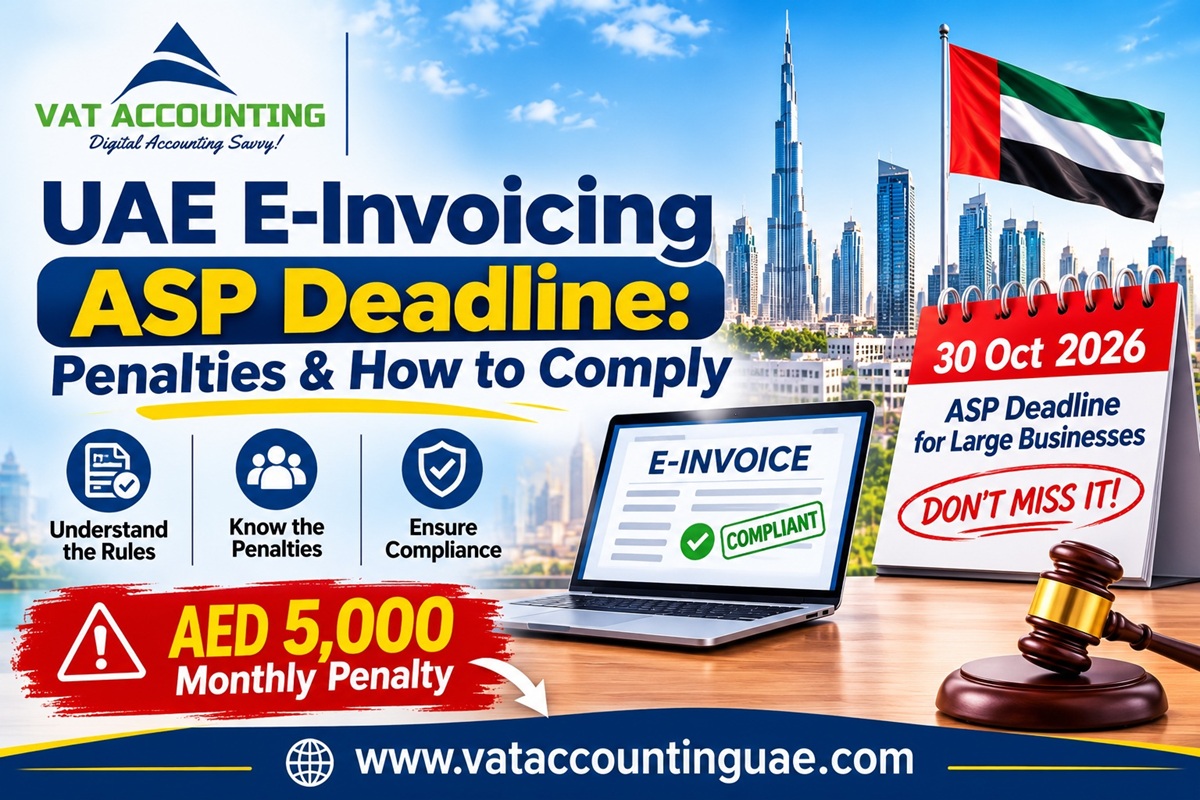
The UAE e-invoicing ASP deadline for large businesses has now come and gone, and many finance teams across Dubai and the wider Emirates are asking the same question: what happens next? Companies with annual revenue of AED 50 million or more were required to appoint an accredited service provider by 30 October 2026, and the countdown to go-live on 1 January 2027 is already running.
If your business has not yet completed this step, there is no need to panic, but there is a need to act quickly. The Ministry of Finance has linked the appointment of a provider to monetary penalties, and a delayed start can also disrupt customer invoicing, supplier payments and VAT reporting once the system becomes mandatory for your business.
Smaller businesses are not exempt from the conversation. Those with revenue below AED 50 million have their own provider deadline in March 2027, and their larger customers will begin sending structured e-invoices much earlier. Understanding the UAE e-invoicing ASP deadline for your category is therefore the first step in any serious compliance plan.
This guide explains what an ASP is, which dates apply to large businesses and SMEs, how the penalties work and what to do if you missed the date. It also gives a clear step-by-step path to compliance, so that your Dubai business can move from uncertainty to a confident, well-documented e-invoicing setup that stands up to questions from customers, auditors and the authorities.
What Is an ASP Under UAE E-Invoicing?
An accredited service provider, or ASP, is a company approved by the Ministry of Finance to connect businesses to the national e-invoicing network. Under the framework introduced through Ministerial Decisions No. 243 and No. 244 of 2025, taxpayers do not send invoices to the authority directly. Instead, they work through an accredited service provider UAE regulators have vetted for security and technical capability.
The UAE follows a decentralised model built on the Peppol framework, commonly described as a five-corner model. Your business sends an invoice to its provider, that provider passes it to your customer’s provider, and the customer delivers it to the buyer, while the relevant tax data is reported to the authority. Every step happens in a standard structured format rather than as a simple PDF.
In practical terms, the ASP:
- Converts your invoice data into the required format
- Validates mandatory fields
- Transmits the document to your customer’s provider
- Handles incoming invoices from your suppliers
Both the sender and the receiver of an invoice must have a provider, which means even companies that mainly buy rather than sell need to complete this appointment before their phase begins.
Choosing the right provider matters because it becomes the technical backbone of your invoicing. The best fit is a provider that integrates smoothly with your accounting or ERP software, supports the UAE data standard, offers reliable support and keeps your records secure. A hasty choice made only to beat a date can create costly rework later, so speed should never replace careful evaluation.
UAE E-Invoicing ASP Deadline: Large Businesses vs SMEs
The phased rollout gives different businesses different dates, so it is important to identify which group you belong to. A pilot programme began on 1 July 2026 for selected taxpayers, allowing early adopters to test the system. The mandatory phases follow, and the UAE e-invoicing mandatory 2027 timeline starts with the largest taxpayers before moving to the rest of the market.
1 July 2026
Pilot programme begins for selected taxpayers.
30 October 2026
ASP appointment deadline for businesses with annual revenue of AED 50 million or more (after an earlier extension).
1 January 2027
Go-live for businesses with annual revenue of AED 50 million or more.
31 March 2027
ASP appointment deadline for businesses with annual revenue below AED 50 million.
1 July 2027
Go-live for businesses with annual revenue below AED 50 million.
1 October 2027
Mandatory adoption for government entities.
The large-business group includes many trading, manufacturing, real estate and service firms operating in Dubai and the other emirates, and it is the group now under the most time pressure. The two-stage design gives smaller firms more time, but it does not remove the need to prepare early and choose a provider carefully. If you are in the smaller group, follow our UAE e-invoicing readiness checklist for SMEs.
Remember that your revenue band determines your date, not your location. A company in Dubai, Abu Dhabi or Sharjah follows the same federal timeline. Dates can also be revised by the authorities, as the earlier extension showed, so always confirm the current position with the Ministry of Finance before you finalise your internal plan and budget.
UAE E-Invoicing Penalties for Missing the ASP Deadline
AED 5,000 for each month, or part of a month
The Ministry of Finance has set an administrative penalty of AED 5,000 for each month, or part of a month, in which a business delays implementing the system or appointing an ASP within the required period. These UAE e-invoicing penalties apply from the point the deadline lapses and continue until the business becomes compliant.
The phrase part of a month is important. A delay of only a few days can still trigger a full AED 5,000 charge, and each additional month of delay adds another. Over a long delay, the total can become a significant and entirely avoidable cost, especially for businesses that are otherwise doing everything right with their VAT, accounting and reporting.
Fines are only one part of the risk. Without a provider, a business cannot send or receive compliant e-invoices once its phase begins. That can mean rejected invoices, delayed customer payments, disputes with suppliers and difficulty keeping VAT records aligned with the invoices that were actually exchanged during the period.
There is also a reputational side. Large customers and public entities will expect their suppliers to be ready, and a supplier that cannot exchange invoices electronically may be treated as a risk. Handling the UAE e-invoicing ASP deadline seriously protects not only your cash but also your commercial relationships and your standing in the market.
What to Do If You Missed the ASP Deadline
1. Act now
Every additional month adds exposure, and a provider appointed this week is far better than one appointed next quarter. Start by confirming your revenue band and your obligations under the current Ministry of Finance guidance.
2. Document your steps
Create a short internal record showing when you began the process, which providers you evaluated and who is responsible for the project. This shows good faith and is useful when auditors, advisers or management ask about your e-invoicing status.
3. Move quickly through onboarding
Shortlist accredited providers, request demonstrations with your own invoice samples and agree a realistic timeline for integration and testing. With go-live on 1 January 2027, your priority is a working connection, not a perfect system.
4. Speak to your tax adviser
Your exact penalty exposure depends on your circumstances and the final guidance. A trusted adviser can help you manage e-invoicing compliance with Dubai requirements and avoid compounding the problem with further delays.
How to Comply: Step-by-Step
Step 1: Assess your needs
Anyone wondering how to appoint ASP in UAE should begin with a simple needs assessment. List your invoicing volumes, the systems you use, the number of entities and branches you operate and the teams involved in billing.
Step 2: Shortlist and appoint
Shortlist providers from the official accredited list published by the Ministry of Finance. Compare integration support, onboarding time, support quality, security standards and pricing. Ask for a test environment and involve both finance and IT in the final decision.
Step 3: Prepare your data
Customer and supplier names, tax registration numbers, addresses, product descriptions and tax categories must be accurate and consistent, because mandatory fields are validated automatically. Update invoice templates and master data before live transmission begins.
Step 4: Test, train and archive
Run end-to-end test invoices, train your sales, procurement and finance teams on the new workflow, and set up secure electronic archiving for the required retention period.
Businesses that follow these steps usually find that e-invoicing becomes a routine part of the month-end rather than a source of stress.
How VAT Accounting UAE Can Help
VAT Accounting UAE is a Dubai-based firm that provides VAT registration, accounting and bookkeeping, corporate tax registration and corporate tax return filing. Because e-invoicing sits at the centre of these services, our team understands how invoice data flows into VAT returns and tax filings, and why accuracy at the source matters so much for your overall compliance.
We help businesses understand where they stand against the UAE e-invoicing ASP deadline, prepare the data and processes needed for a smooth setup and coordinate with the provider they select. Our approach is practical: we focus on clear timelines, clean records and documentation that you can rely on if questions arise later from customers or authorities.
For small and medium companies, our support is especially useful. UAE e-invoicing for SMEs often means upgrading old spreadsheets, aligning teams and learning new terminology at the same time as running a busy business. We simplify these steps so that your team can stay focused on customers while your compliance work moves forward steadily.
Need Help With Your ASP Appointment?
Share your current setup with our team, and we will outline a simple, step-by-step path tailored to your size, sector and timeline, so that you can face the new system with confidence.
Conclusion
The UAE e-invoicing ASP deadline has already passed for the largest businesses, but the opportunity to recover and comply is still open. Acting now limits UAE e-invoicing penalties, protects customer relationships and puts your finance team on solid ground before the first mandatory phase begins on 1 January 2027.
For smaller businesses, the 31 March 2027 provider deadline is a chance to plan calmly rather than react in a rush. Reviewing software, cleaning data and shortlisting providers early makes the whole process cheaper and far less stressful, and it keeps your invoicing running smoothly during the transition.
The path is straightforward: confirm your date, appoint an accredited provider, prepare your data, test thoroughly and archive properly. Every step is manageable when taken in order, and every step reduces risk for your business, your customers and your suppliers across Dubai and the wider UAE.
If you would like expert support, VAT Accounting UAE is ready to help. Reach out to our Dubai team and turn the UAE e-invoicing ASP deadline from a source of worry into a clear, well-managed project that keeps your business compliant and confident.
Frequently Asked Questions
What is the UAE e-invoicing ASP deadline?
The UAE e-invoicing ASP deadline is the date by which a business must appoint an accredited service provider. For businesses with annual revenue of AED 50 million or more it was 30 October 2026, and for all other businesses it is 31 March 2027. Dates can change, so confirm them with the Ministry of Finance.
What happens if my business misses the ASP deadline?
Your business may face a penalty of AED 5,000 for each month, or part of a month, of delay. You should appoint a provider immediately, keep a written record of the steps you take and speak to your tax adviser about your exact position and any further guidance from the authorities.
How much is the penalty for delaying ASP appointment?
The administrative penalty is AED 5,000 per month, or part of a month, for delay in implementing the system or appointing a provider within the required timeline. Because partial months count, even a short delay can trigger a full charge, and the amount grows with every additional month.
What is the ASP deadline for SMEs?
Businesses with annual revenue below AED 50 million must appoint an ASP by 31 March 2027 and begin e-invoicing from 1 July 2027. The date may seem distant, but preparation takes time, and larger customers will start sending structured invoices well before your own go-live date arrives.
Who needs to appoint an accredited service provider?
Businesses within the e-invoicing mandate need to appoint an accredited service provider UAE authorities have approved, because the provider sends and receives invoices on their behalf. Both issuers and recipients of invoices need a provider to exchange documents on the national network.
When does e-invoicing become mandatory in the UAE?
The first phase starts on 1 January 2027 for businesses with annual revenue of AED 50 million or more. Other businesses follow from 1 July 2027, and government entities from 1 October 2027, as part of the wider UAE e-invoicing mandatory 2027 timeline set by the Ministry of Finance.
Is the ASP requirement different in Abu Dhabi?
There is no difference. The requirement is federal, so it applies equally in Abu Dhabi, Sharjah and every other emirate. If you are searching for e-invoicing ASP Abu Dhabi guidance, the same dates, penalties and compliance steps described in this article apply to your business as well.
How do I choose the right ASP?
Compare providers on integration with your accounting system, onboarding speed, support quality, data security and pricing. Request a test environment, send sample invoices and involve both finance and IT before deciding, rather than choosing only on price or on how quickly the provider can start.
Can I change my ASP later?
Switching providers may be possible, but it can mean rework, fresh testing and temporary disruption to your invoicing. It is best to choose carefully the first time. Review the contract terms and the provider’s support commitments before signing, and confirm any rules on switching with the provider and the authorities.
How can VAT Accounting UAE help with e-invoicing?
VAT Accounting UAE helps Dubai businesses understand their dates, clean their invoicing data and coordinate with their chosen provider, while also handling VAT, accounting and corporate tax work. Contact our team to receive a clear, step-by-step compliance plan suited to your business size and timeline.